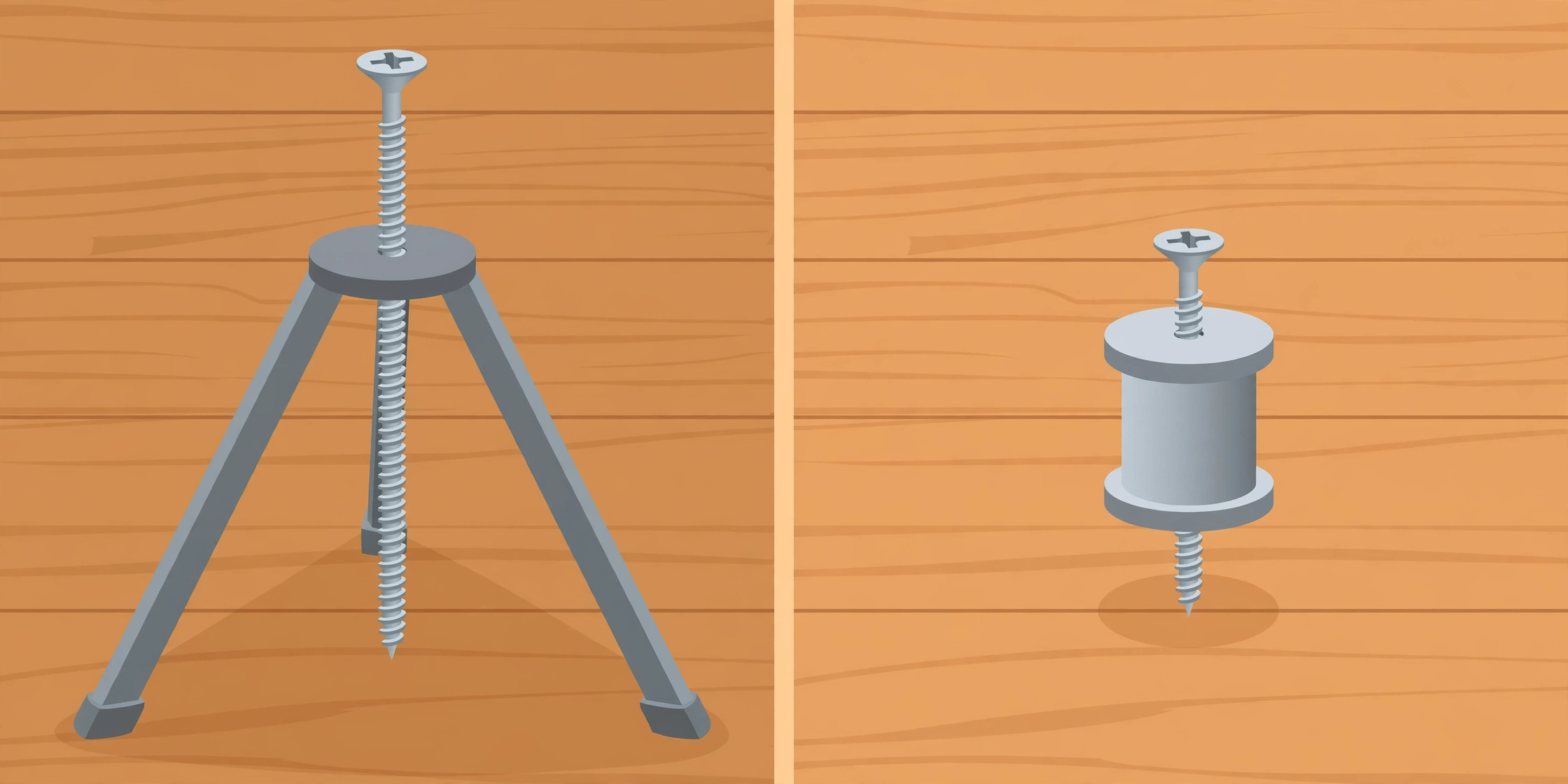
If you’ve decided to fix your squeaky floor from above with a breakaway-screw kit, you’ll run into two names over and over: Squeeeeek No More (from O’Berry Enterprises) and Counter-Snap (also from O’Berry Enterprises). They look similar, they cost about the same, and they both promise the same thing — a screw you drive through the floor that snaps off below the surface, pulling the floor tight to the joist with almost no visible trace.
So which one should you buy? Here’s the quick answer, then the full breakdown.
Quick verdict: If any of your squeaks are under carpet — or you might have carpeted squeaks in the future — get the Squeeeeek No More full kit. Its tripod fixture lets you drive screws right through carpet, which Counter-Snap can’t do. If every squeak you own is on bare hardwood (or stairs), Counter-Snap is the simpler, more focused kit and gets the job done just as well. Price is nearly identical, so buy based on your floors, not your wallet.
I haven’t lab-tested these side by side — this comparison is based on how each system is designed, what’s in each box, and which situations each one is built for. The good news is that neither one is a bad buy; they’re both variations on a proven idea.
How Breakaway-Screw Kits Work (The 60-Second Version)
The concept is the same for both kits, and it’s clever. You get screws with a score line partway down the shank. You drive the screw through the hardwood (and subfloor) into the floor joist using a special fixture that controls the depth. At the right moment, you snap the screw head off at the score line. What’s left is a threaded screw buried below the floor surface, clamping the flooring sandwich tight to the joist — and a small hole, roughly 1/8 inch, that you fill and forget about.
No nails to work loose later. No prying up boards. No refinishing. That’s the whole appeal: a permanent, nearly invisible fix you can do with a drill in an afternoon.
Squeeeeek No More: The All-Rounder
Squeeeeek No More is the older, better-known name — O’Berry Enterprises has been selling squeak repair hardware for decades, and this is their flagship kit (model 3233 if you’re comparison shopping).
What’s in the box
- 50 scored breakaway screws (3-inch, wax-coated to drive easier)
- 2 joist-finding screws — thin probes you drive to confirm you’ve found solid joist wood before committing a real screw
- Square-head driver bit sized for the screws
- Tripod fixture for carpet — a three-legged guide that parts carpet fibers so you can drive through carpet without damaging it
- Hardwood adapter — the fixture you use on bare hardwood, vinyl, or linoleum
- Instructions
Strengths
It handles carpet. This is the big one. The tripod fixture spreads carpet fibers apart, you drive the screw through into the joist, the head snaps off, and the fibers close back over the spot. No pulling carpet, no re-stretching. If you have wall-to-wall carpet anywhere in the house, this is the only kit of the two that can deal with it.
The joist-finding screws are genuinely useful. Finding the joist from above is the hardest part of this job, and the kit includes dedicated probe screws for it. Drive one at your marked spot: solid resistance after the subfloor means joist, free sinking means you’re between joists. It takes the guesswork out of the most error-prone step.
One kit for the whole house. Hardwood in the living room, carpet in the bedrooms, vinyl in the kitchen — the full kit covers all of them. If you have more than one squeak in more than one type of flooring, one box does it all.
Limitations
More parts than you might need. If all your squeaks are on bare hardwood, the tripod fixture just sits in the box. You’re paying for carpet capability you won’t use — though the price difference between this and Counter-Snap is small enough that it hardly matters.
Watch which version you’re buying. Squeeeeek No More also sells a hardwood-only version of the kit without the tripod fixture. It’s cheaper, but if you buy it and later discover a squeak under carpet, you’ll wish you’d gotten the full kit. When in doubt, get the complete kit (model 3233) — the one with the tripod.
The fixture takes a minute to learn. The tripod isn’t complicated, but first-timers should practice the drive-and-snap motion on a scrap area or an inconspicuous spot before tackling the squeak in the middle of the living room.
Counter-Snap: The Hardwood Specialist
Counter-Snap comes from O’Berry Enterprises — the same company behind Squeeeeek No More — and it’s the more focused product: a breakaway-screw kit designed specifically for bare hardwood floors (and stairs). No carpet hardware, no extras — just the hardwood job.
What’s in the box
- 50 scored breakaway screws
- 1 driver bit
- 1 counter-snap fixture — the depth-control guide for hardwood
That’s it. Notably, there are no joist-finding screws in the box.
Strengths
Simplicity. One fixture, one job. If your house is all hardwood and you just want to silence a few squeaks, there’s nothing to figure out and nothing extra rattling around in the box.
Designed for the hardwood snap depth. The Counter-Snap fixture is calibrated so the screw snaps about 1/4 inch below the top of the hardwood — the right depth for a clean fill on a wood surface. It’s a small detail, but it’s the detail that decides whether your patch disappears or shows.
Works on stairs. Both kits handle stairs, but Counter-Snap’s hardwood-first design makes it a natural pick for squeaky stair treads, where you’re always working on bare wood.
Limitations
No carpet capability at all. This is the dealbreaker for carpeted floors. The kit is explicitly not for carpet — there’s no tripod, no fiber-parting fixture. If you have even one squeak under carpet, this kit can’t help you with it.
No joist-finding screws included. You’ll need to locate joists the old-fashioned way: tapping and listening for the solid thud, measuring 16 inches on center from a wall, peeking behind baseboard or a floor vent, or probing with a finish nail. It works fine — people did it this way long before the kits existed — but the Squeeeeek No More probes are a genuinely nice shortcut, and you’ll miss them.
Less versatile overall. Hardwood, vinyl, and stairs — that’s the whole territory. Fine if that matches your house; limiting if it doesn’t.
Head-to-Head
| Squeeeeek No More (full kit) | Counter-Snap | |
|---|---|---|
| Screw count | 50 | 50 |
| Carpeted floors | Yes — tripod fixture included | No |
| Bare hardwood | Yes — hardwood adapter | Yes — purpose-built |
| Stairs | Yes | Yes |
| Vinyl / linoleum | Yes | Yes |
| Joist-finding screws | Yes (2 included) | No |
| Driver bit | Yes | Yes |
| Typical price | Mid-$20s | Similar range |
| Best for | Mixed flooring, any carpet | All-hardwood homes |
On price, there’s no meaningful gap — both kits land in the same neighborhood, so let price be a tiebreaker at most. The real decision is about your floors.
Which Should You Buy? By Scenario
“My squeaks are under carpet.” Squeeeeek No More, full kit, no contest. It’s the only one of the two that can go through carpet.
“All hardwood, no carpet anywhere.” Either works. I’d lean Counter-Snap for its simplicity — fewer parts, purpose-built for exactly your situation. But if there’s any chance you’ll want the kit again for a carpeted room someday, the Squeeeeek No More full kit is the safer long-term buy.
“Squeaky stairs.” Either kit handles stairs, since stair treads are bare wood. Counter-Snap’s hardwood-first design is a natural fit, but Squeeeeek No More’s hardwood adapter does the same job.
“I’ve never done this before and I’m nervous about finding the joist.” Squeeeeek No More. The included joist-finding screws take the hardest part of the job — confirming solid wood before you commit — from guesswork to a two-minute test.
“I have squeaks in several rooms with different flooring.” Squeeeeek No More full kit. One box, every surface, done.
How to Use Either Kit Well
Whichever kit you buy, the technique is the same — and technique matters more than brand. Get these right and either kit will give you a silent, invisible repair.
Find the exact spot first. Have someone walk the squeaky area while you listen, mark the spot with painter’s tape, and confirm it by pressing down on the mark — if the squeak stops under pressure, you’ve got the right place. Rushing this step is the number one reason these kits “don’t work” for people. The screw has to go into the moving spot, not near it.
Confirm the joist. The screw must bite into solid joist wood, not just subfloor. Use the kit’s probe screws if you have them; otherwise tap the floor listening for the solid thud over a joist versus the hollow sound between joists, or probe with a finish nail. A screw that misses the joist fixes nothing and leaves a hole for your trouble.
Drive straight down. Keep the drill at 90 degrees. An angled screw can wander off the joist or split the flooring tongue. The fixture exists to keep you straight — let it do its job. Drive until the fixture stops you or the head snaps; don’t force it past the snap.
Fill the hole properly. The snapped screw leaves a small hole, roughly 1/8 inch. Wax filler sticks in a matching wood tone are the easiest fix — rub in, buff off the excess. Colored wood putty works for slightly larger holes. Fill slightly proud of the surface and level it once dry; on most floors you’ll never find the spot again.
Stop if something feels wrong. This is the safety rule that matters: if your probe or screw hits resistance that doesn’t feel like wood — a sudden hard stop, or the screw refusing to advance — back it out and move at least two inches to either side. Floors can hide plumbing runs, electrical cable, and in some homes, radiant heating tubing. Never force a fastener through mystery resistance. If your home has in-floor radiant heat, think twice about driving fasteners from above at all — the from-below methods (shims, adhesive) are much safer there.
When a Kit Won’t Fix It
Breakaway-screw kits are for the common case: a loose board or a subfloor gap flexing against a joist. They are not a fix for structural problems, and no kit will help if the squeak is a symptom of something bigger.
Call it off and investigate further — or call a pro — if you notice the floor bouncing or feeling spongy underfoot, visible sagging, water stains or soft spots near the squeak, cracked or badly notched joists, squeaks spreading across a large area over a few months, or any sign of rot or insect damage. A kit clamps wood together; it can’t fix wood that’s failing. Get the diagnosis right first — a squeak is cheap to fix, but only if it’s actually just a squeak.
The Bottom Line
Both kits are built on the same proven idea, both cost about the same, and both will permanently silence an ordinary squeak when the screw lands in the joist. The choice comes down to one question: do you have carpet? If yes — or maybe someday — buy the Squeeeeek No More full kit for its tripod fixture and joist-finding screws. If your home is all bare hardwood and stairs, Counter-Snap is the simpler tool for the job. Either way, find the spot, confirm the joist, drive straight, and fill the hole — do that, and the squeak is gone.
Frequently Asked Questions
Do these kits work on carpet?
Squeeeeek No More does — its tripod fixture parts the carpet fibers so you can drive the screw through without damaging the carpet, and the fibers close back over the spot afterward. Counter-Snap does not work on carpet; it’s designed for bare hardwood, vinyl, and stairs only.
Will the screw hole show?
Barely, if you fill it. The snapped screw leaves a hole roughly 1/8 inch wide. A wax filler stick in a matching wood tone, rubbed in and buffed, makes it disappear on most floors. On carpet, there’s effectively nothing to see — the fibers cover the spot.
What if I miss the joist?
Then the screw spins in the subfloor without clamping anything, and the squeak stays. That’s why confirming the joist before driving matters so much — use the kit’s joist-finding screws, tap-test for the solid sound, or probe with a finish nail. If you do miss, fill the hole and move a half inch toward the joist line.
Can I use these kits on stairs?
Yes, both. Stair squeaks are usually a tread rubbing against a riser or stringer, and a breakaway screw driven into solid wood below the tread works the same way as on a flat floor. Counter-Snap’s hardwood-first design is a natural fit here.
How many screws does one squeak need?
Often just one or two at the marked spot. If the squeak persists, add more screws along the joist line on either side of the first one — sometimes the movement spans a wider area than it sounds like. Each kit includes 50 screws, which is plenty for a whole house of squeaks.
Are the screws strong enough to hold permanently?
Yes. The threaded portion stays buried in the joist, clamping the flooring layers together, and unlike the smooth nails that caused the squeak in the first place, screw threads don’t work loose with seasonal wood movement. The head snapping off doesn’t weaken anything — the head’s only job was to let you drive it.
Can I pull the screw out later if I need to?
Not easily — that’s the tradeoff of a headless screw. There’s nothing to grab. In practice this rarely matters, since the screw is doing exactly what you want it to do permanently. If you ever need to pull up that board for another reason, you’d cut around or drill out the screw like any other buried fastener.
Which kit is better for a first-timer?
Squeeeeek No More, mainly because of the two joist-finding screws in the box. Locating the joist is the step beginners get wrong most often, and the probes turn it into a simple test instead of a guessing game. The technique is the same either way — find the spot, confirm the joist, drive straight.