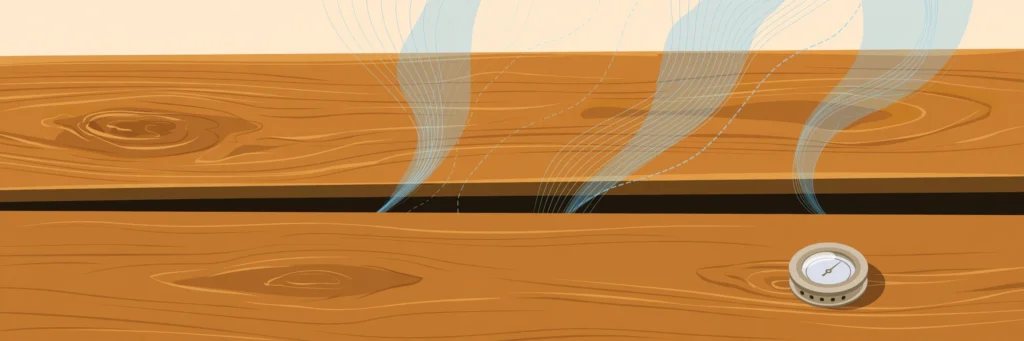
Few things alarm a homeowner quite like watching hairline cracks open up between hardwood floor boards. One summer the floor looks seamless; by February, dark lines run between the boards like someone drew them with a pencil. Before you panic, it helps to know this: in most cases, gaps between hardwood floor boards are not a defect. They are wood doing exactly what wood does — expanding and contracting with the moisture in the air around it.
That said, not every gap is harmless. Some gaps point to an installation mistake, some to decades of slow drying, and a few to genuine structural trouble underneath. This guide walks through every common cause, explains how to tell normal seasonal movement from a real problem, and ends with the single most important insight of all: many gaps are a humidity problem wearing a floor problem’s disguise, and fixing the humidity fixes the gap.
The Short Answer: Wood Shrinks When It Loses Moisture
Hardwood flooring is a hygroscopic material, which is just a technical way of saying it absorbs and releases water vapor from the surrounding air until it reaches equilibrium with its environment. When indoor air gets dry, boards give up moisture and shrink. When air gets humid, they absorb moisture and swell.
Here is the detail that matters: wood does not shrink evenly. It shrinks much more across its width (tangentially, following the growth rings) than along its length. A 3.25-inch wide oak board can change width by roughly 1/8 inch or more between a humid summer and a dry winter. Multiply that tiny change by the dozens of boards spanning a room, and the cumulative effect shows up as visible gaps — usually at the butt joints and long seams where boards meet.
This movement is built into the material. No wood species is exempt, though some are more stable than others. Rift-sawn and quarter-sawn boards move less than plain-sawn ones. Engineered flooring moves far less than solid wood because its plywood core resists the seasonal push and pull. But any solid hardwood floor will move with the seasons, at least a little.
Cause #1: Seasonal Humidity Changes (The Most Common Cause by Far)
If your gaps appear every winter and mostly close every summer, you have already found your answer. Indoor relative humidity follows the weather, and heating systems make it worse. Cold outdoor air holds very little moisture; when your furnace warms that air up, its relative humidity plummets. A house that sits at 45–50% relative humidity in July can easily drop to 20–25% in January with forced-air heat.
Wood flooring professionals generally target 35–55% relative humidity (some manufacturers say 30–50%) for a stable floor. Drop below about 30% for weeks, and solid hardwood starts shrinking enough to open gaps. The wider the boards, the more dramatic the effect — wide-plank floors can show gaps you can slide a coin into during a dry winter, while narrow strip flooring in the same house shows only hairlines.
Watch the calendar pattern, because it is diagnostic:
- Gaps that open in winter and close in summer: seasonal humidity movement. Normal, expected, and almost never a defect.
- Gaps that are worst near heat registers, fireplaces, or sunny windows: localized dry spots where forced heat or direct sun is over-drying specific boards.
- Gaps that appear after you start running a whole-house dehumidifier: the floor is responding to its new, drier equilibrium.
- Gaps in only one room or one area: check for a localized cause — a heat vent blasting directly onto the floor, a nearby wood stove, or air leaks drying that zone.
The fix here is environmental, not cosmetic. Filling a seasonal gap with rigid filler is like caulking an expansion joint on a bridge — the movement has not gone away, and the filler will crack, crumble, or push out when the boards swell again in summer. The right response is to raise indoor humidity back into the floor’s comfort range with a humidifier, and let the boards close the gaps themselves.
Cause #2: Installation Without Proper Acclimation
Before hardwood is installed, the boards need to acclimate — sit in the home where they will be installed, in the conditions they will live in, long enough for their moisture content to match the home’s. Most manufacturers recommend at least 72 hours (some specify longer), with the HVAC running at normal living temperature and humidity. The wood and the subfloor should both be moisture-tested before a single board goes down.
When acclimation is skipped or rushed, trouble follows on both ends:
- Wood installed too wet: Boards installed at higher moisture content than the home’s normal level will shrink as they dry out over the first heating season. The gaps that open are often the widest and most noticeable — and the most preventable.
- Wood installed too dry: Boards installed unusually dry for the home will swell in the first humid season, potentially buckling or cupping as they expand against each other with nowhere to go.
Acclimation gaps typically show up within the first year or two, and they are often wider than purely seasonal gaps. If a new floor developed large gaps in its very first winter, poor acclimation is the leading suspect — especially if the installation happened during a humid summer and the first dry winter shrank boards that were never given time to adjust.
This is also why the subfloor moisture reading matters. A subfloor that reads too wet can feed moisture into the boards after installation, or dry out and pull moisture back out, extending the floor’s unstable period.
Cause #3: Years of Slow Drying and Aging
Even a perfectly installed floor changes over time. Over years and decades, hardwood gradually loses moisture-binding capacity as its internal structure ages — the wood’s chemistry slowly changes, a process sometimes called hornification. Older boards simply do not hold as much moisture as they did when new, so their “summer” swelling becomes less pronounced while their “winter” shrinkage stays the same. The net effect: gaps that used to close completely in July now stay slightly open year-round.
Long-term gaps from aging share a few fingerprints:
- They are stable — roughly the same width in January and July, unlike seasonal gaps.
- They appear gradually, widening over years rather than weeks.
- They often show in floors that are 15–30+ years old, sometimes alongside other age signs like surface wear, minor cupping, or color change.
- They may be accompanied by crumbly, missing filler from a previous repair, if someone tried to fill them years ago.
Aging gaps are cosmetic in most cases. The floor has found its new equilibrium, and unless the gaps are wide enough to trap debris or let drafts through, many homeowners simply live with them. When they are filled, it should only be after confirming they do not move with the seasons — stable gaps are safe to fill; moving gaps are not.
Cause #4: Subfloor, Joist, and Structural Issues
Sometimes the problem is not the boards at all — it is what is underneath them. If the subfloor or framing shifts, the boards riding on top have to move too, and the seams between them can open as a result.
Structural causes worth ruling out:
- Subfloor moisture damage: A plumbing leak, appliance drip, or chronic dampness can soften or swell the subfloor in spots. When it later dries, it can shrink or crumble, leaving boards unsupported and gaps widening over the damaged area.
- Joist movement or settlement: Houses settle, and floor joists can deflect or sag slightly over time. If a floor dips, boards separate at the low point and gaps concentrate there.
- Missing or failed subfloor: In older homes, boards may have been nailed directly to joists with no subfloor, or the subfloor panels may have delaminated. Movement in the structure translates straight into board movement.
- Boards loosening from fasteners: Nails can work loose over decades of foot traffic and seasonal cycling. A board that is no longer held snug against its neighbor will drift and leave a gap that grows wider.
How to tell structural gaps from seasonal ones: structural gaps usually do not follow the weather. They stay open year-round, often cluster in one area (over a known plumbing run, near an exterior wall, at a doorway threshold), and may come with companion symptoms — squeaking, bouncing or spongy feel underfoot, visible sagging, or cracked drywall below. Seasonal gaps, by contrast, come and go with the heating season and distribute fairly evenly across a room.
If you suspect a structural cause, look in the basement or crawl space under the affected area. Water stains, mold, cracked or notched joists, and punky subfloor are all visible from below and point to a repair that starts underneath the floor, not on top of it.
Normal Seasonal Gaps vs. Red Flags: How to Tell
Use these rules of thumb when you inspect your floor:
Almost certainly normal:
- Gaps appear in late fall/winter and close in spring/summer
- Gaps are narrow (under about 1/8 inch) and fairly even across the room
- The floor is solid hardwood in a climate with real winters
- No other symptoms — no squeaks, no bouncing, no visible dips
Worth watching:
- Gaps that used to close in summer but no longer do (possible long-term drying; monitor over a year)
- Gaps concentrated in one room or near one vent (localized drying; check airflow and humidity there)
- Gaps with cracked or crumbling old filler (a previous cosmetic fix on a moving gap; the movement is the real issue)
Red flags — investigate further:
- Gaps over 1/4 inch wide that stay open year-round
- Gaps clustered in one spot with spongy feel, squeaks, or visible sagging
- Gaps appearing alongside water stains, musty odors, or mold
- Gaps widening quickly over weeks rather than gradually over seasons
- New gaps appearing in an engineered floor (which moves far less than solid wood, so persistent gaps suggest something else is wrong)
A quick test: buy an inexpensive [AFFILIATE: digital hygrometer] and measure the relative humidity in the room with the gaps, then measure again in midsummer. If the gap width tracks the humidity reading, the floor is simply responding to its environment. If wide gaps persist at 45% humidity in July, something beyond weather is going on.
When Gaps Signal a Humidity Fix, Not a Filler Fix
This is the mistake most homeowners make: they see a gap and reach for wood filler, when the gap is actually a symptom of dry air. Here is how to decide which fix the gap is asking for.
It is a humidity fix when:
- The gaps are seasonal (open in winter, close in summer)
- A humidity reading shows indoor RH below about 35%
- The gaps appeared or worsened after the heat came on
- The gaps are fairly uniform across the room
In these cases, the right move is to humidify. A [AFFILIATE: whole-home humidifier] tied to the HVAC system is the most reliable solution for forced-air homes; portable room units work for smaller areas but need regular refilling and cleaning. Bring indoor humidity into the 35–55% range and hold it there for a few weeks, and most seasonal gaps will close on their own. Only then — with the floor at its humid-season width — should you judge whether any remaining gaps are worth filling.
It is a filler fix when:
- The gaps are stable year-round (measure them in winter and again in summer)
- Humidity is already in the normal range and gaps persist
- The floor is old and the gaps reflect long-term drying
- The gaps are wide enough to collect dirt or feel underfoot, and the boards are not moving
Filler, rope caulk, or wood slivers all have their place — but only on gaps that have stopped moving. Matching the repair method to the gap size and stability is a whole subject of its own.
If gaps make your boards move underfoot, you may also be dealing with squeaks — see how to fix squeaky hardwood floors for how to silence a noisy floor.
Frequently Asked Questions
Why do hardwood floor gaps appear in winter and disappear in summer?
Heated winter air has very low relative humidity, so boards lose moisture and shrink across their width, opening gaps. In summer, humid air lets boards reabsorb moisture and swell, closing the gaps. It is normal seasonal movement, not damage.
Are gaps between hardwood floor boards normal?
Narrow seasonal gaps are completely normal for solid hardwood. Uniform movement across a room, opening in winter and closing in summer, is exactly what the material is supposed to do. Persistent, wide, or localized gaps deserve a closer look.
How much gap is too much in a hardwood floor?
As a rough guide: under 1/8 inch seasonal is normal; up to 1/4 inch in a dry winter happens with wide-plank floors; anything over 1/4 inch that stays open year-round, or gaps that keep widening, should be investigated for installation, moisture, or structural causes.
Will gaps in hardwood floors close on their own?
Seasonal gaps usually close on their own when humidity rises in spring and summer. Stable gaps from long-term drying or poor acclimation generally will not close on their own and need either humidity correction or a physical repair.
Should I fill gaps in my hardwood floor?
Only fill gaps that are stable — the same width in winter and summer. Filling seasonal gaps with rigid filler almost always fails: the boards will swell in summer and crack or push out the filler. Fix the humidity first, then fill what remains.
Can a humidifier fix gaps in hardwood floors?
Yes, if the gaps are seasonal. Raising indoor relative humidity into the 35–55% range lets shrunken boards reabsorb moisture and swell back toward their normal width. Give it a few weeks of consistent humidity before judging the result.
Do engineered hardwood floors get gaps?
Much less than solid wood, because the layered construction resists movement. Persistent gaps in an engineered floor are unusual and more likely to indicate a subfloor, moisture, or installation issue than normal seasonal movement.
When should I call a professional about floor gaps?
Call a flooring professional if gaps exceed 1/4 inch and stay open year-round, if gaps cluster over a sagging or spongy area, if you see water stains or mold, or if an engineered floor is developing gaps. A moisture meter reading of the boards and subfloor is the standard diagnostic step.
The bottom line: most gaps between hardwood floor boards are the floor breathing with the seasons. Measure your humidity, watch the calendar pattern, and fix dry air before you ever open a tube of filler. The gaps are telling you something — usually that the air, not the floor, needs attention.