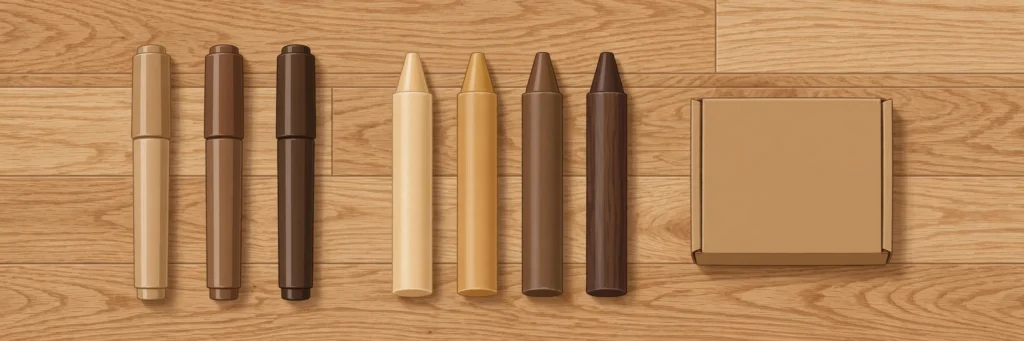
A scratched hardwood floor does not always need a professional refinish. For surface scratches, scuffs, and small nicks, a well-chosen repair kit can make damage nearly invisible in under ten minutes. But the shelf is crowded — stain markers, wax filler sticks, crayon-style touch-up sticks, and all-in-one kits all claim to fix scratches, and they are not interchangeable. Pick the wrong type and the repair looks worse than the scratch.
This guide compares five repair kit styles side by side on kit contents, color range, ease of use, and best use case, so you can match the product to your floor and your damage. The comparison is built from product specifications, material properties, and established wood-finishing principles — no lab tests, no sponsored rankings. Three winners are named at the end: best overall, best budget, and best for dark floors.
How Scratch Repair Actually Works
Stain markers. Felt-tip markers filled with wood-tone stain. They color the raw wood exposed by a scratch so it blends with the surrounding finish. Best for shallow surface scratches. They add color, not material — they cannot fill a dent.
Wax filler sticks. Solid wax sticks in wood tones, melted or rubbed into gouges to fill missing material level with the surface, then buffed smooth. Best for deeper scratches, nicks, and chips where wood is actually missing.
Touch-up crayons. Crayon-form color with a harder wax base — easier to control than liquid stain, less filling power than true wax sticks.
All-in-one kits. Bundles combining markers, filler sticks, and sometimes a sharpener, buffing cloth, or color-mixing guide. Best for varied damage across multiple rooms.
The damage hierarchy: surface scuff in the finish only → marker or crayon. Scratch through the finish into the wood → marker to recolor. Gouge or chip with missing wood → wax filler stick. Damage across a large area or worn finish → no kit fixes this; that is a screen-and-recoat or refinish job.
What to Compare Before Buying
Four factors separate a good kit from a disappointing one:
- Kit contents. Does it include only markers, or markers plus filler sticks? A kit with both handles more damage types. Bonus items like sharpeners, mixing charts, and buffing pads add real value.
- Color range. Hardwood floors span pale maple to near-black walnut and espresso stains. A kit with 6 to 8 shades covers most floors; a kit with 3 shades forces you to blend and hope. For dark floors, dedicated dark tones matter more than total shade count.
- Ease of use. Markers are the simplest — uncap and draw. Wax sticks require warming, pressing, leveling with a plastic scraper or credit card, and buffing. None of this is difficult, but it affects how likely you are to actually do the repair instead of living with the scratch.
- Best use case. A renter touching up move-out scuffs needs something different from a homeowner maintaining dark walnut floors with two dogs. Match the kit to the job.
One more factor: finish compatibility. Most kits work over polyurethane, the most common modern finish. On oil or wax finishes, test in a closet corner first — stain markers can behave unpredictably on oil-finished wood.
The 5 Picks, Compared
1. Complete All-in-One Repair Kit (Markers + Wax Sticks + Accessories)
The default recommendation for most households: one box covering the full damage hierarchy. A typical configuration includes 6 to 8 stain markers, 6 to 8 wax filler sticks in matching tones, a sharpener, a plastic leveling scraper, a buffing cloth, and sometimes a color-mixing guide.
- Kit contents: The strongest of the five — markers for surface scratches, wax sticks for gouges, plus the tools to apply both.
- Color range: Usually 12 to 16 pieces across 6 to 8 wood tones, from light oak and maple through cherry, walnut, and espresso.
- Ease of use: Moderate. Markers are foolproof; wax sticks take one practice attempt to learn the warm-fill-level-buff rhythm.
- Best use case: Varied damage across rooms — pet scratches here, a furniture gouge there — handled with one purchase.
The tradeoff is price, but buying markers and wax sticks separately costs more than the bundle, so the kit wins on value if you need both product types.
2. Budget Stain Marker Set (6-Pack)
The simplest product on the list: six felt-tip stain markers in common wood tones, nothing else. No filler, no tools.
- Kit contents: Minimal — markers only. Recolors scratches; does not fill them.
- Color range: Six shades covering light oak, golden oak, cherry, mahogany, walnut, and espresso. Adequate for surface scratches on most stained floors; thin for very pale maple or near-black ebony.
- Ease of use: The easiest of the five. Uncap, color along the grain, wipe excess immediately. Under a minute per scratch.
- Best use case: Renters doing move-out touch-ups, or homeowners whose damage is limited to shallow scratches and scuffs.
The limitation is structural: on anything deeper than a surface scratch, a marker darkens the gouge but the dent remains visible in raking light. For shallow damage, though, it is the highest return-per-dollar repair product available.
3. Dark Floor Specialist Kit (Wax Sticks + Markers in Deep Tones)
Dark floors — espresso, dark walnut, jacobean, ebony-stained oak — are the hardest to touch up, because a slightly-off color reads as a gray or ashy smudge against the dark background. General-purpose kits often top out at “walnut.” A dark-floor kit concentrates its entire range in the deep end of the spectrum.
- Kit contents: Typically 4 to 6 wax filler sticks plus 3 to 4 markers, all in dark tones, sometimes with a black stick for the deepest stains and chips.
- Color range: Narrow but deep — multiple dark browns with different undertones (red-brown, neutral brown, near-black) instead of one token dark shade.
- Ease of use: Moderate. Buff thoroughly after filling — excess wax shows as a light haze on dark floors.
- Best use case: Any floor darker than medium walnut, especially homes with pets whose claws leave pale scratches that contrast sharply against dark stain.
If your floor is dark, this kit outperforms a general all-in-one kit despite fewer total pieces, because every piece is a shade you will actually use.
4. Professional-Grade Wax Filler Stick Set
The filler-first option: 10 to 12 wax sticks with minimal or no markers, aimed at deeper damage — gouges from dragged furniture, chipped board edges, clawed thresholds. The wax in these sets tends to be harder than all-in-one bundle sticks, so repairs hold up better under foot traffic once leveled and buffed.
- Kit contents: Wax sticks only, but more of them, sometimes with two scraper profiles (flat and beveled) for tight spots between boards.
- Color range: The widest of the five — 10 to 12 shades. Blending two adjacent tones for an exact match becomes practical rather than aspirational.
- Ease of use: The most involved. Warm the stick (a hair dryer for a few seconds), press firmly into the gouge slightly overfilling, level with the scraper, let cool, then buff. Rushing the leveling step leaves a visible ridge.
- Best use case: Real gouges and chips that markers cannot fix — including stair nosings and thresholds, which take abuse markers cannot cover.
The honest caveat: wax filler is cosmetic, not structural. On a high-traffic threshold it may need refreshing yearly; in low-traffic areas a careful fill lasts years.
5. Touch-Up Crayon and Marker Combo
Pairs crayon-style touch-up sticks with a smaller set of liquid markers — typically 6 crayons and 6 markers. Crayons handle light scratches with more control than liquid markers (less risk of over-darkening surrounding finish); markers handle raw-wood scratches needing real stain penetration.
- Kit contents: Mid-range — two product types, no leveling tools or buffing cloth. An old credit card works as the scraper.
- Color range: Usually 6 tones, each in both crayon and marker form. Crayon for the light pass, marker for the deep scratch, in the same tone family.
- Ease of use: Easy. Crayons are the most forgiving product type — color outside the lines and buff the excess off with your thumb.
- Best use case: Light-to-moderate wear, especially for anyone nervous about making a repair look worse. The crayon-first approach is nearly mistake-proof.
This sits between the budget marker set and the all-in-one kit in price and capability — the right pick when you want more control than markers alone but do not need full wax-filling power.
Quick Comparison
| Kit | Contents | Shades | Ease of use | Fixes gouges? | Best for |
|---|---|---|---|---|---|
| 1. All-in-one kit | Markers + wax + tools | 12–16 pcs, 6–8 tones | Moderate | Yes | Most households, varied damage |
| 2. Budget marker set | Markers only | 6 tones | Easiest | No | Renters, surface scratches |
| 3. Dark floor kit | Wax + markers, deep tones | 7–10 pcs, dark only | Moderate | Yes | Espresso/walnut/ebony floors |
| 4. Pro wax stick set | Wax sticks + scrapers | 10–12 tones | Most involved | Yes, best | Deep gouges, chips, thresholds |
| 5. Crayon + marker combo | Crayons + markers | 6 tones x2 formats | Easy | Light only | Nervous beginners, light wear |
The Winners
Best overall: the complete all-in-one repair kit. The only pick covering the full damage hierarchy — markers for surface scratches, wax sticks for gouges, and the tools to apply both. For one kit in the junk drawer, versatility beats specialization. [AFFILIATE: all-in-one-hardwood-repair-kit]
Best budget: the 6-pack stain marker set. Erases the most common floor damage — surface scratches and scuffs — in under a minute per scratch, for pocket change. Its limitation (no filling power) is honest and clearly bounded.
Best for dark floors: the dark floor specialist kit. Dark stain shows every color mismatch, and general kits do not carry enough deep tones. A kit built entirely around dark browns and near-blacks solves the exact problem dark-floor owners have.
How to Get a Repair That Disappears
The product matters less than the technique:
- Clean first. Wipe the scratch with a damp cloth and let it dry. Dirt in the scratch becomes a dark line under stain.
- Go lighter first. Start a shade lighter than you think. You can layer darker; you cannot easily lighten an over-darkened repair.
- Work with the grain. Strokes along the grain disappear; strokes across it draw attention.
- Wipe excess immediately. Excess stain on surrounding finish darkens a halo around the repair. Color the scratch, then wipe the area with a dry cloth.
- Test in a closet. Floor stain varies by batch and age — test inside a closet before touching the living room.
For wax fills: slightly overfill, then level. Wax shrinks a little as it cools, and an underfilled gouge catches light and shadow.
What Repair Kits Cannot Fix
- Worn-through finish across large areas — gray, lifeless patches where traffic wore past the stain. Needs screening and recoating.
- Deep scratches across many boards — a refinishing problem, not a touch-up problem.
- Water damage — black staining, cupping, or warping. Filler over water damage traps the problem.
- Seasonal gaps between boards — normal wood movement, not damage. Filling them creates a mess when boards swell back in summer humidity.
If more than about 10 percent of a room shows damage, price a professional screen-and-recoat before buying kits. Touch-up is for isolated damage; refinishing is for widespread wear.
For a full walkthrough of the repair process, see our guide to how to fix scratches on hardwood floors.
Frequently Asked Questions
Do hardwood floor scratch repair kits really work?
Yes, within their limits. Stain markers reliably conceal shallow scratches by recoloring exposed wood, and wax filler sticks effectively fill small gouges and chips. They do not fix worn-through finish, water damage, or widespread wear — those need professional refinishing. For isolated scratches, a kit repair is often invisible from standing height.
What is the difference between stain markers and wax filler sticks?
Stain markers add color only — they recolor raw wood in a shallow scratch. Wax filler sticks add color and material — they fill the physical depression of a gouge or chip level with the surface. Marker for scratches you can barely feel with a fingernail; wax stick for damage you can see as a dent.
How do I match the repair kit color to my floor?
Start a shade lighter than the floor and test in a closet. Stain varies by batch, age, and sun exposure, so plan to layer or blend two adjacent tones for an exact match. For dark floors, choose a kit with multiple dark tones rather than blending up from medium walnut.
Can I use a scratch repair kit on engineered hardwood?
Yes, for surface scratches and shallow scratches in the veneer — the same techniques apply. Be cautious with deep gouges: the veneer is thin, and aggressive filling or sanding can break through to the core. If a gouge goes through the veneer, professional repair is safer.
Will the repair hold up to mopping and foot traffic?
Marker touch-ups hold up well — the stain sits in the wood fibers like the original stain. Wax fills are softer and can wear down in high-traffic areas like thresholds, where they may need yearly refreshing. Neither is harmed by normal damp mopping; avoid soaking the area and skip steam mops on any wood floor.
Should I sand the scratch before using a repair kit?
For shallow scratches, no — sanding removes surrounding finish and enlarges the repair area. For rough gouges with splintered edges, lightly smooth raised edges with fine (220-grit) sandpaper before filling. Keep spot repairs as small as possible.
Are repair kits safe for homes with pets and kids?
Once dry, markers and wax fillers are inert solids in or on the wood — comparable to the floor finish itself. Apply with the room ventilated and store the products away from children and pets like any household chemical. For strong chemical sensitivities, look for low-VOC formulations on the label.
When should I call a professional instead of using a kit?
When damage covers a large area (roughly 10 percent of a room or more), the finish is worn through to gray wood, there is water damage (black staining, cupping, warping), or scratches are deep and numerous. A good rule: if you are buying your third kit for the same room, it is time for a quote.